What are the most common vocal issues singers actually face, and how can we prevent them without falling into the trap of overthinking every tiny symptom? In this engaging and refreshingly honest chat, ENT voice specialist Nick Gibbins breaks down the patterns he sees in clinic, alongside practical insights on building vocal stamina and injury prevention. The conversation tackles what can actually be detected via laryngostroboscopy, reflux, hypermobility, rehabilitation, and Nick also tackles some questions from you, the listeners. Expect expert knowledge, myth-busting, and plenty of down-to-earth, relatable discussion that every singer and teacher will benefit from hearing.
WHAT’S IN THIS PODCAST?
5:21 What singers does Nick see in clinic?
8:16 Patterns of challenge and injury in singers
13:06 Reflux
17:38 Preparing for vocal load increase
24:10 What can you actually tell about a singer via laryngostroboscopy?
26:46 Hypermobility
36:25 Surgery and recovery
41:08 Singing teachers and rehabilitation
47:52 Can you feel your vocal folds?
54:22 Vocal hygiene without the hype
About the presenter HERE
RELEVANT MENTIONS & LINKS
Singing Teachers Talk – Ep.87 How to Manage Allergies and Upper Respiratory Infections
Singing Teachers Talk – Ep.201 Working with Hypermobile Singers
British Laryngological Association
ABOUT THE GUEST
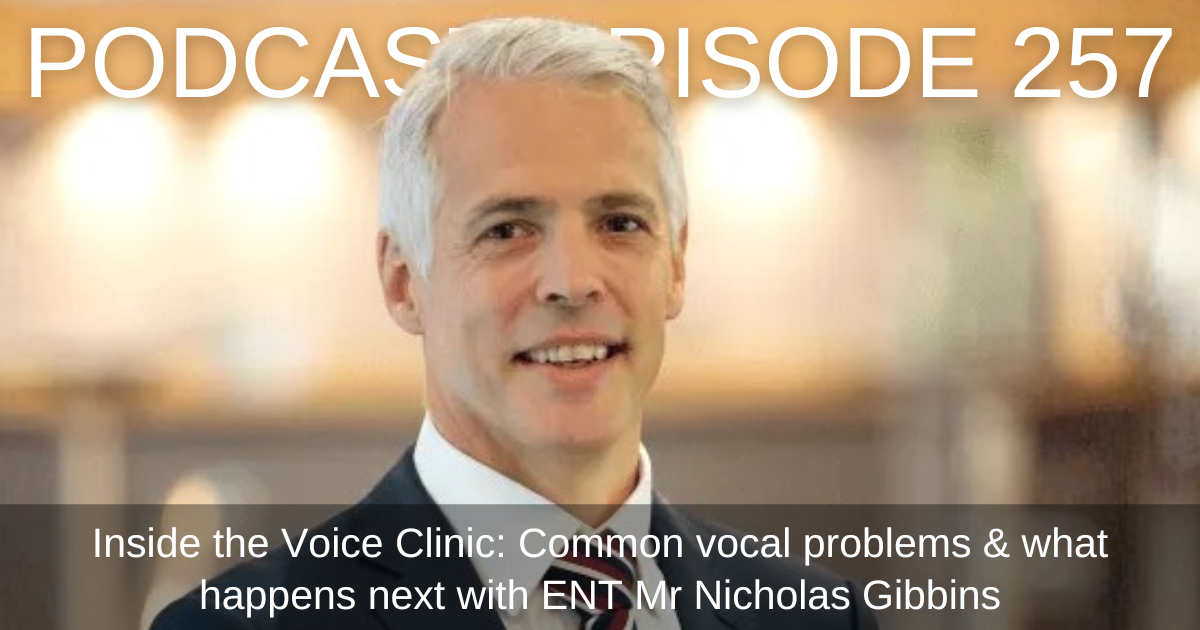
Mr Nicholas Gibbins is a Consultant Laryngologist and Head & Neck Surgeon at the University Hospital Lewisham. Trained in London and the South-East of England, Nick has built a reputation as an excellent surgeon, teacher and lecturer. Patient outcomes are a key focus for Nick and, along with the whole of the renowned voice team at Lewisham, has built the largest Voice Database in Europe to analyse outcomes.
His key interests in the voice are the diagnosis and treatment of vocal fold scars and sulci, and the care and treatment of the professional voice. More recently he has been sought after to lecture on musculoskeletal problems that can either originate in the larynx causing muscle tension imbalance or that arising distally and effect the biomechanics of the voice. He has built a team that can address all these issues that includes speech therapists, osteopaths, vocal rehabilitation coaches, kinetic chain specialists, gastroenterologists, neurologists and more.
He writes and publishes regularly and is the current Editor of the Chapter on the Larynx for Gray’s Anatomy (43rd Ed). His term of office as President of the British Laryngological Association began in 2025.